
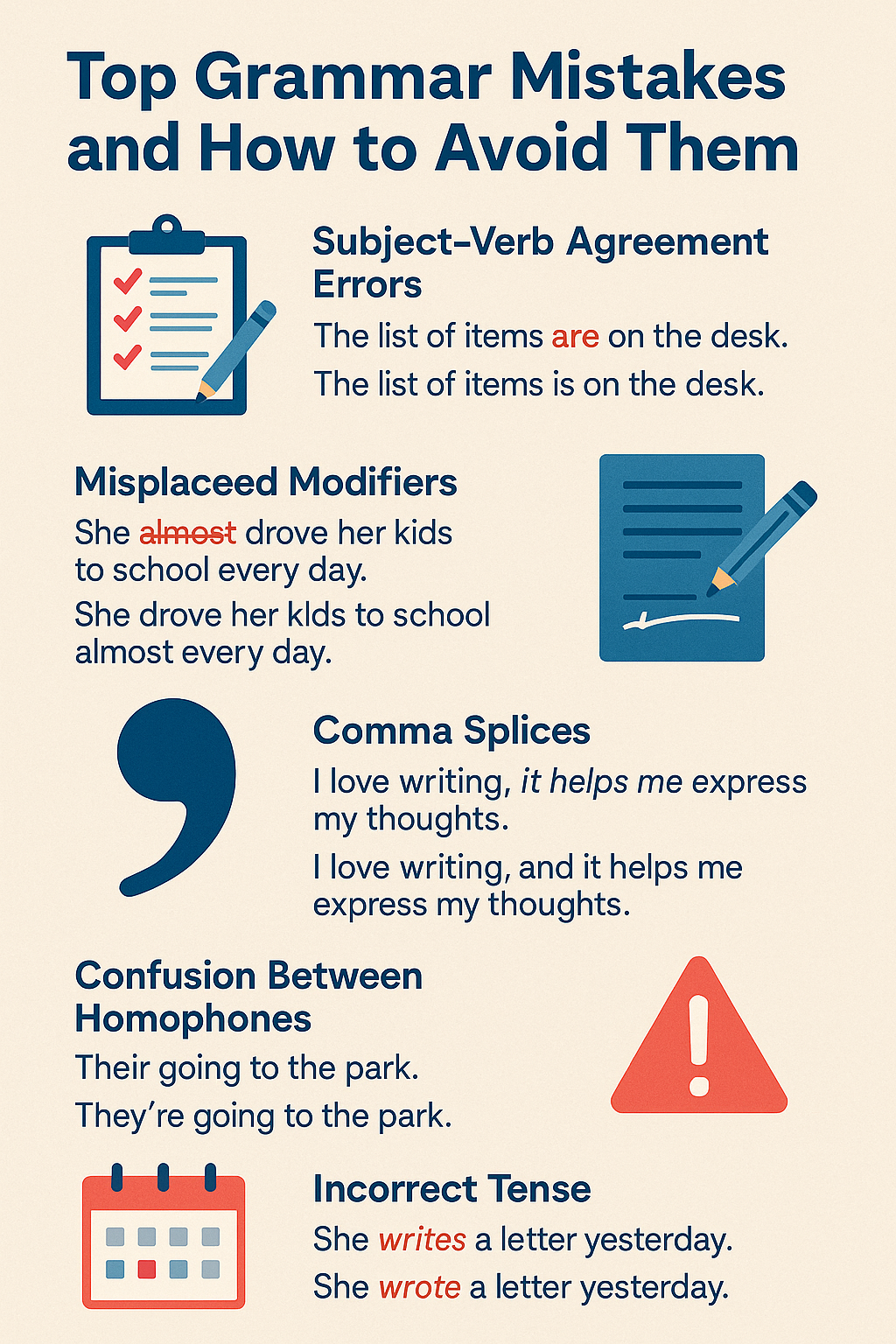
Mastering grammar is essential for producing clear and professional writing. Whether you’re writing academic essays, blog posts, or business emails, grammar mistakes can distract your readers and damage your credibility. In this article, we’ll explore some of the most common grammar mistakes and provide practical tips on how to avoid them.
Subject-Verb Agreement Errors
One of the most frequent grammar mistakes is subject-verb agreement. This occurs when the subject of a sentence does not match the verb in number (singular or plural).
Example of an error:
The list of items are on the desk.
Correct version:
The list of items is on the desk.
Tip to avoid this mistake:
Identify the true subject of the sentence. In the example, the subject is “list,” which is singular, so the verb should also be singular.
Misplaced Modifiers
Misplaced modifiers can make sentences confusing or unintentionally funny because they seem to describe the wrong part of the sentence.
Example of an error:
She almost drove her kids to school every day.
(This implies she nearly did it but didn’t.)
Correct version:
She drove her kids to school almost every day.
Tip to avoid this mistake:
Place modifiers as close as possible to the words they describe to maintain clarity.
Run-On Sentences and Comma Splices
Run-on sentences occur when two or more independent clauses are joined without proper punctuation. A comma splice happens when two independent clauses are incorrectly connected with just a comma.
Example of an error (run-on):
I love writing it helps me express my thoughts.
Example of an error (comma splice):
I love writing, it helps me express my thoughts.
Correct versions:
I love writing. It helps me express my thoughts.
I love writing; it helps me express my thoughts.
I love writing, and it helps me express my thoughts.
Tip to avoid this mistake:
Use periods, semicolons, or conjunctions to separate independent clauses.
Incorrect Use of Apostrophes
Apostrophe mistakes are very common, especially when showing possession or creating contractions.
Example of an error:
Its a beautiful day.
(This should be a contraction for “it is.”)
Correct version:
It’s a beautiful day.
Also, avoid making plurals with apostrophes:
Incorrect: The cat’s are sleeping.
Correct: The cats are sleeping.
Tip to avoid this mistake:
Remember: Use apostrophes for contractions (it’s = it is) and possession (the dog’s bone).
Confusion Between Homophones
Homophones are words that sound alike but have different meanings and spellings. Commonly confused homophones include:
- Their / There / They’re
- Your / You’re
- Its / It’s
- To / Too / Two
Example of an error:
Their going to the park.
Correct version:
They’re going to the park.
Tip to avoid this mistake:
Double-check homophones during proofreading, especially if you rely on spellcheck tools.
Sentence Fragments
A sentence fragment is an incomplete sentence that lacks a subject, a verb, or a complete thought.
Example of an error:
Because I was tired.
Correct version:
I went to bed early because I was tired.
Tip to avoid this mistake:
Ensure that each sentence has a subject, a verb, and expresses a complete idea.
Overuse of Passive Voice
While passive voice is grammatically correct, overusing it can make your writing weak and unclear.
Example (passive voice):
The essay was written by John.
Improved version (active voice):
John wrote the essay.
Tip to avoid this mistake:
Use active voice when you want to create stronger and more engaging sentences.
Dangling Modifiers
A dangling modifier is a descriptive phrase that doesn’t clearly and logically refer to a word in the sentence.
Example of an error:
Running to the store, the rain started pouring.
(This makes it sound like the rain was running to the store.)
Correct version:
As I was running to the store, the rain started pouring.
Tip to avoid this mistake:
Make sure every descriptive phrase is clearly attached to the correct subject.
Using Incorrect Tense
Switching between past, present, and future tense within the same context confuses readers.
Example of an error:
She writes a letter yesterday and mails it today.
Correct version:
She wrote a letter yesterday and mailed it today.
Tip to avoid this mistake:
Stay consistent with your verb tense throughout your writing.
Improper Use of Commas
Commas are often misused, leading to confusion or a change in sentence meaning.
Example of an error:
Let’s eat grandma.
Correct version:
Let’s eat, grandma.
Tip to avoid this mistake:
Use commas to clarify meaning, separate items in a list, and set off introductory phrases.
How to Improve Your Grammar Over Time
Mastering grammar takes time and practice. Here are some ways to improve:
- Read regularly to observe proper grammar in action.
- Use grammar-check tools like Grammarly or Hemingway Editor.
- Take online grammar quizzes to test your knowledge.
- Edit your writing carefully before submission.
Building Confidence in Your Writing
By learning to recognize and correct these common grammar mistakes, you’ll produce clearer and more professional writing. Consistent practice and attention to detail will help you avoid errors and build confidence in your writing skills.