
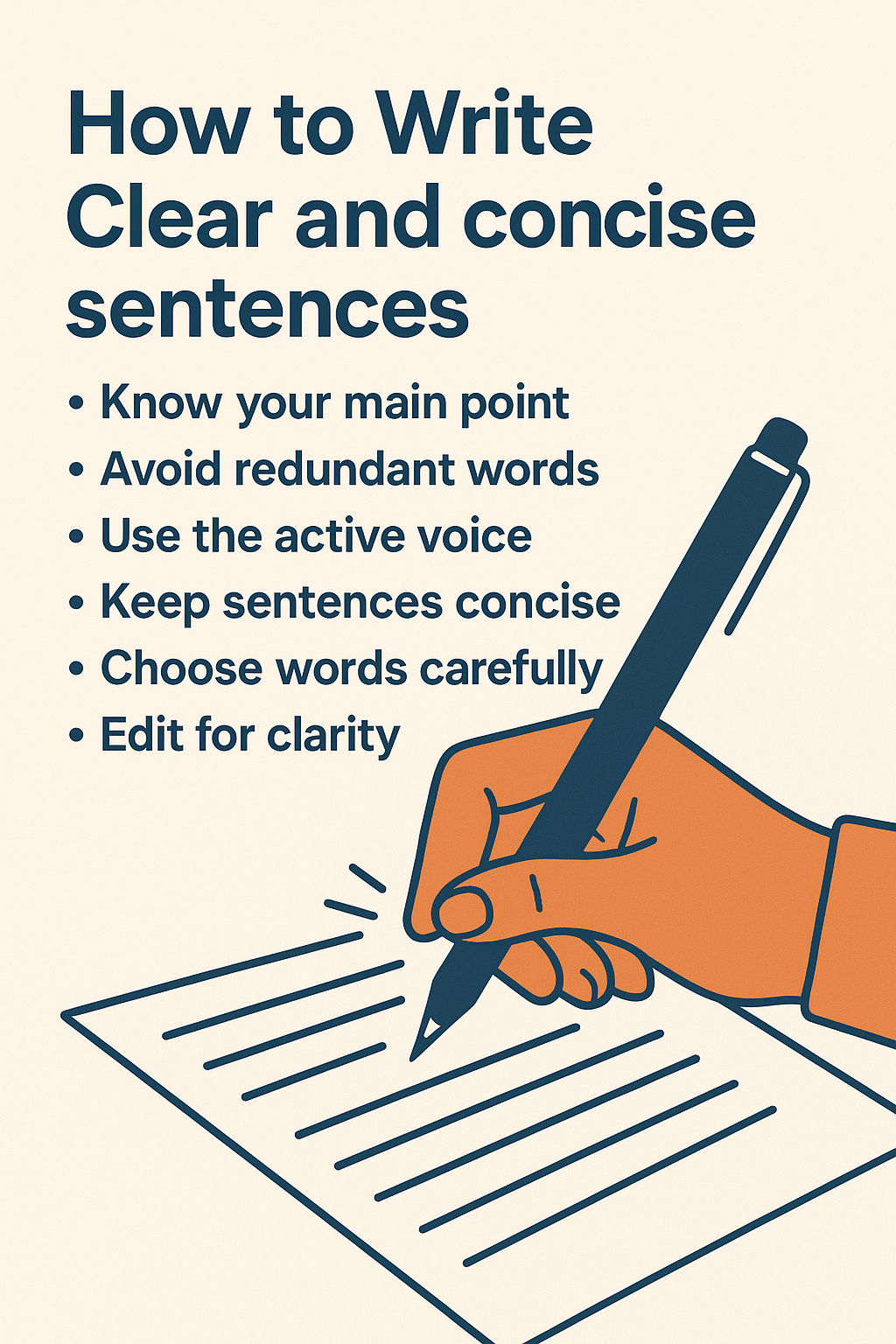
Clear and concise writing is essential for effective communication. Whether you’re crafting blog posts, academic papers, business emails, or creative stories, using straightforward sentences helps ensure your message is easily understood. In this article, we’ll explore techniques for writing clear and concise sentences that engage readers and improve your overall writing style.
Why Clarity and Conciseness Matter
Long, wordy, or confusing sentences can frustrate readers and dilute your message. Clear and concise writing:
- Enhances readability
- Improves comprehension
- Keeps the reader engaged
- Reduces the risk of misinterpretation
- Creates a professional and polished tone
Your goal is to deliver your ideas in the simplest and most effective way possible.
Understand the Core Message of Each Sentence
Before writing or editing a sentence, ask yourself:
- What is the main point I want to communicate?
- Is every word necessary to convey this point?
- Can I simplify the structure without losing meaning?
Focusing on the core message helps eliminate unnecessary words.
Example:
Wordy:
Due to the fact that the meeting was postponed, we had to reschedule all of our appointments.
Concise:
Because the meeting was postponed, we rescheduled our appointments.
Eliminate Redundant Words and Phrases
Redundancy makes writing longer than necessary. Look for phrases that repeat the same idea.
Common redundant phrases:
- “Advance planning” → “Planning”
- “Close proximity” → “Proximity”
- “End result” → “Result”
- “In order to” → “To”
Example:
Wordy:
In order to succeed, you must work hard.
Concise:
To succeed, you must work hard.
Use Active Voice Instead of Passive Voice
Active voice creates more direct and engaging sentences.
Passive voice:
The report was written by Sarah.
Active voice:
Sarah wrote the report.
While passive voice is not grammatically wrong, active voice often makes sentences clearer and more dynamic.
Replace Weak Verbs with Strong Verbs
Strong verbs make your writing more impactful.
Weak verb:
He gave an explanation for his behavior.
Strong verb:
He explained his behavior.
Choosing precise verbs reduces the need for extra words.
Avoid Unnecessary Qualifiers
Words like “very,” “really,” “quite,” and “somewhat” often add little value.
Example:
Wordy:
She was very excited about the opportunity.
Concise:
She was excited about the opportunity.
Or, use a stronger adjective:
She was thrilled about the opportunity.
Break Up Long Sentences
Long sentences can confuse readers. If a sentence contains multiple ideas, break it into two or more shorter sentences.
Example:
Long and confusing:
Despite the fact that the project was delayed due to unforeseen circumstances, we managed to complete it on time by working overtime and reallocating resources.
Improved and concise:
The project was delayed due to unforeseen circumstances. However, by working overtime and reallocating resources, we completed it on time.
Use Specific and Concrete Language
Specific language is clearer than vague language.
Vague:
The company experienced some issues recently.
Specific:
The company faced production delays and customer service complaints last month.
Providing details helps readers understand your point more easily.
Remove Filler Words
Filler words add length without adding meaning. Common fillers include:
- Just
- Really
- That (when unnecessary)
- Actually
- Basically
Example:
Wordy:
I just wanted to let you know that I really think the meeting went well.
Concise:
I think the meeting went well.
Edit Ruthlessly
First drafts often contain extra words and unclear sentences. During editing:
- Read each sentence aloud.
- Look for opportunities to cut words.
- Focus on clarity and simplicity.
- Replace long phrases with shorter alternatives.
Practice Regularly
Like any skill, writing clear and concise sentences improves with practice.
Here are a few exercises:
- Take a long paragraph and rewrite it in half the word count.
- Challenge yourself to write social media posts with a strict character limit.
- Rewrite articles or essays using simpler language.
Over time, concise writing will become second nature.
Final Thoughts: Strengthening Your Writing with Clarity
Clear and concise sentences improve the flow, readability, and effectiveness of your writing. By focusing on your main message, removing unnecessary words, and choosing strong verbs, you’ll create content that captures your audience’s attention and delivers your ideas with impact.
Start applying these techniques today and watch your writing become sharper and more engaging.