
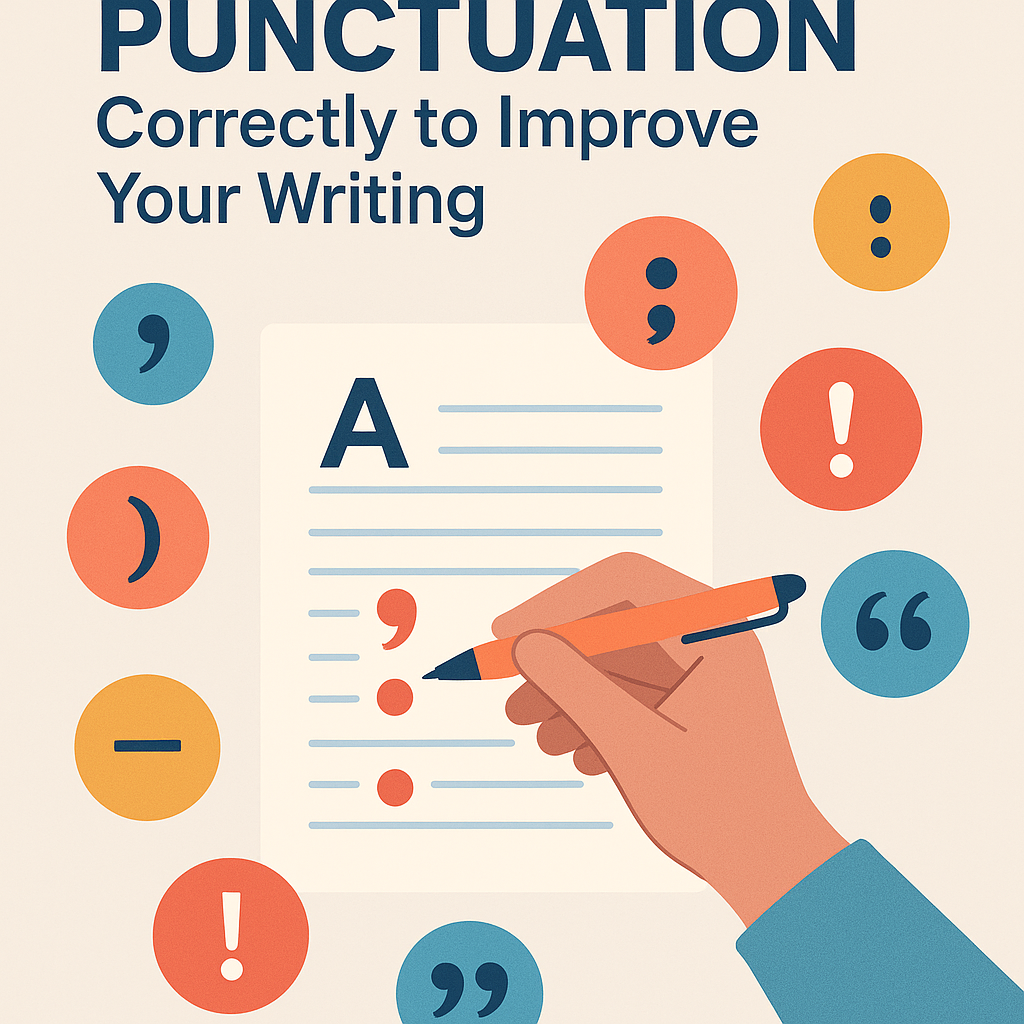
Punctuation marks are small symbols, but their impact on writing is enormous. They guide the reader, clarify meaning, and provide rhythm and flow to sentences. Misusing punctuation can confuse your audience, change the meaning of your sentences, and reduce the professionalism of your text. Mastering the correct use of punctuation is an essential skill for anyone aiming to write clearly and effectively.
Why Punctuation Matters
Imagine reading a paragraph with no punctuation—it would be a chaotic, difficult-to-understand mess. Proper punctuation helps readers:
- Understand the structure of sentences
- Follow the writer’s intended meaning
- Grasp the tone and emotion behind the words
- Pause and breathe at the right moments while reading
Good punctuation ensures that your writing is both readable and professional.
The Most Common Punctuation Marks and How to Use Them
1. Period (.)
Purpose: Marks the end of a sentence.
Example:
Correct: “The project was completed on time.”
Tip: Avoid run-on sentences by ensuring each complete thought ends with a period.
2. Comma (,)
Purpose: Indicates a pause, separates elements in a list, and clarifies meaning.
Examples:
- To separate items in a list: “We bought apples, oranges, and bananas.”
- Before coordinating conjunctions: “She studied hard, but she still failed the test.”
- After introductory phrases: “After the meeting, we went for lunch.”
Common Mistake:
Comma splice: Connecting two independent clauses with just a comma.
Wrong: “She loves coffee, she drinks it every morning.”
Correct: “She loves coffee, and she drinks it every morning.” Or: “She loves coffee; she drinks it every morning.”
3. Semicolon (;)
Purpose: Connects closely related independent clauses or separates complex list items.
Examples:
- “I have a big test tomorrow; I can’t go out tonight.”
- “The conference has attendees from Paris, France; Berlin, Germany; and Tokyo, Japan.”
Tip: Only use a semicolon when both clauses can stand alone as complete sentences.
4. Colon (:)
Purpose: Introduces lists, explanations, or elaborations.
Examples:
- Introducing a list: “You will need the following items: paper, pens, and a notebook.”
- Providing explanation: “He had only one goal: to finish the marathon.”
Tip: Never use a colon after a verb or preposition when listing items.
5. Question Mark (?)
Purpose: Ends direct questions.
Examples:
- “What time is the meeting?”
- “Are you coming with us?”
Tip: Indirect questions do not require a question mark.
Example: “She asked if I was coming with them.”
6. Exclamation Mark (!)
Purpose: Expresses strong emotion or emphasis.
Examples:
- “Watch out!”
- “That was amazing!”
Tip: Use exclamation marks sparingly in formal writing.
7. Quotation Marks (“ ”)
Purpose: Enclose direct speech, quotations, or titles of short works.
Examples:
- Direct speech: She said, “I’ll be there soon.”
- Short story title: “The Lottery”
Tip: In American English, periods and commas typically go inside quotation marks.
8. Apostrophe (’)
Purpose: Indicates possession or forms contractions.
Examples:
- Possession: “Maria’s book”
- Contraction: “It’s raining outside.”
Common Mistakes:
- Confusing “its” (possessive) with “it’s” (contraction for “it is”).
9. Parentheses (())
Purpose: Include extra information or clarification.
Example:
“The CEO (who founded the company in 2005) announced the new policy.”
Tip: Use parentheses sparingly in formal writing.
10. Dash (—) and Hyphen (-)
Dash (—): Separates parts of a sentence for emphasis or adds a dramatic pause.
Example: “She was determined—nothing could stop her.”
Hyphen (-): Connects words in compound terms.
Example: “Well-known author”
Tip: Do not use these marks interchangeably.
Tips for Mastering Punctuation
Read Your Writing Aloud
Hearing your sentences helps identify missing or misplaced punctuation. Natural pauses often signal where punctuation is needed.
Use Online Grammar Tools
Tools like Grammarly and Hemingway App can highlight punctuation mistakes and suggest corrections.
Study Well-Written Texts
Analyze books, articles, and professional content to observe how experienced writers use punctuation effectively.
Practice with Punctuation Exercises
Numerous free online resources offer punctuation exercises. Regular practice can help reinforce the rules.
Focus on Clarity
If you’re unsure whether to use a comma, semicolon, or dash, choose the option that makes your meaning clearest to the reader.
Common Punctuation Mistakes to Avoid
- Overusing commas: Not every pause requires a comma.
- Forgetting periods at the end of sentences: Always double-check that each sentence ends properly.
- Misplacing apostrophes: Learn the difference between possessives and contractions.
- Incorrect use of semicolons: Don’t connect clauses that aren’t complete sentences.
- Excessive exclamation marks: Too many can make your writing seem unprofessional.
Improving Your Writing Through Better Punctuation
Mastering punctuation improves readability, professionalism, and overall communication. Clear and well-punctuated writing is easier for readers to follow and more likely to make the desired impact.
As you continue developing your writing skills, pay special attention to punctuation. With time and practice, using punctuation marks correctly will become second nature, making your writing stronger and more effective.