
A persuasive essay is a type of writing where the goal is to convince the reader to agree with a particular point of view or take a specific action. Mastering the structure of a persuasive essay is essential for presenting your arguments effectively and making a lasting impression on your audience. This article will guide you through each component of a well-structured persuasive essay, helping you build strong, logical, and convincing arguments.
Understanding the Purpose of a Persuasive Essay
Before diving into structure, it’s important to understand what makes a persuasive essay unique. Unlike informative or narrative essays, a persuasive essay focuses on influencing the reader’s beliefs, opinions, or actions.
You’ll need to:
- Present a clear stance on an issue.
- Support your position with logical reasoning and credible evidence.
- Address counterarguments and refute them effectively.
- Use persuasive language and rhetorical techniques.
The Basic Structure of a Persuasive Essay
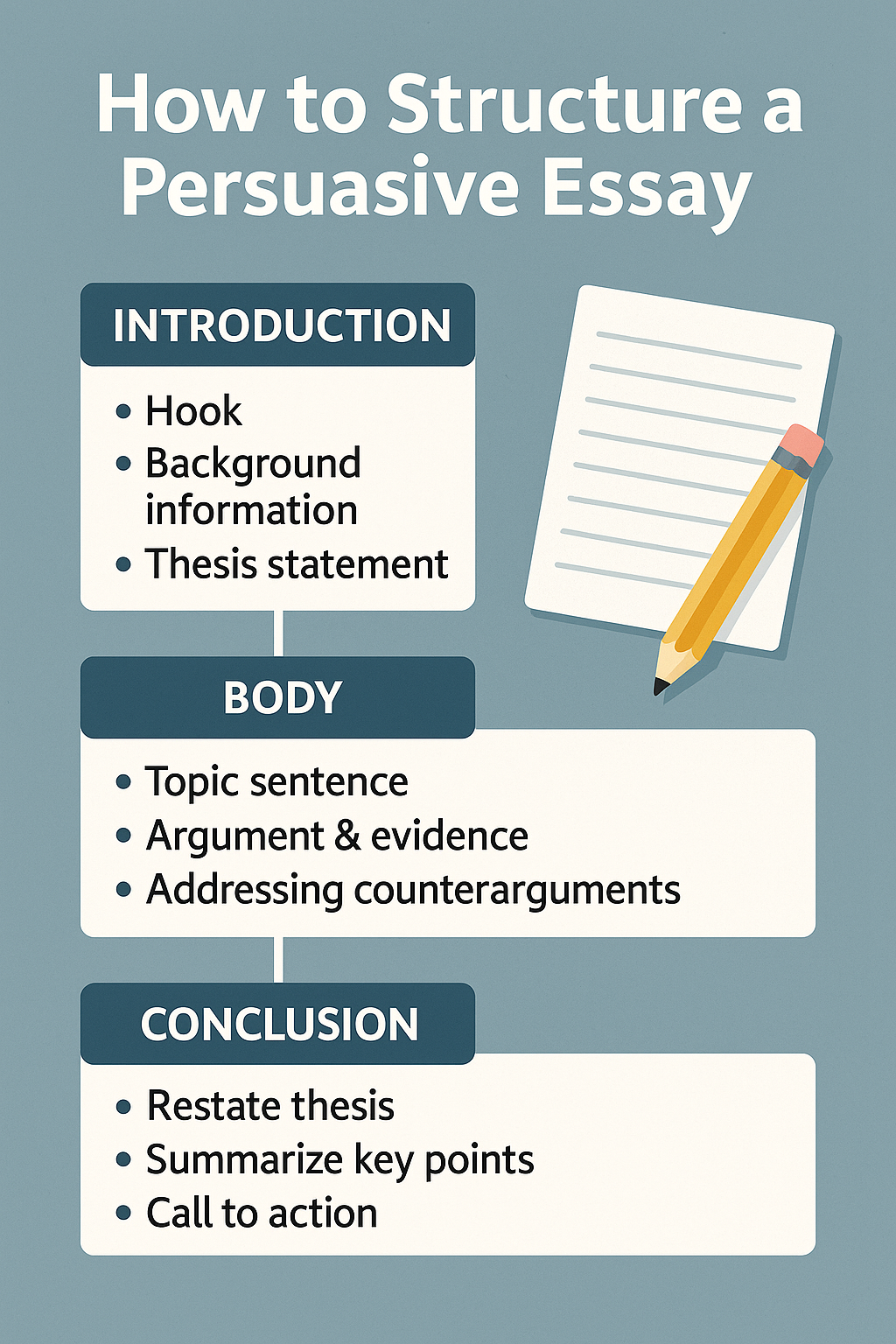
A well-organized persuasive essay typically follows a three-part structure:
- Introduction
- Body Paragraphs
- Conclusion
Let’s break down each section.
Writing a Compelling Introduction
The introduction serves to grab the reader’s attention and introduce the topic. A strong introduction includes:
- Hook: Start with an interesting fact, question, quote, or anecdote that relates to your topic.
- Background Information: Provide context to help the reader understand the issue.
- Thesis Statement: Clearly state your position on the topic. This sentence sets the tone for the rest of the essay and outlines the main argument.
Example Thesis Statement:
“Implementing school uniforms in public schools can improve student focus, reduce peer pressure, and foster a sense of community.”
Crafting Effective Body Paragraphs
Each body paragraph should focus on one main point that supports your thesis. Here’s a recommended structure for each paragraph:
Topic Sentence
Begin with a sentence that introduces the paragraph’s main idea.
Example:
“One key benefit of school uniforms is that they help reduce distractions in the classroom.”
Supporting Evidence
Provide facts, statistics, examples, or expert opinions to back up your point.
Example:
“A study conducted by XYZ University found that students in uniformed schools showed a 15% improvement in concentration levels compared to those in non-uniformed schools.”
Explanation
Explain how the evidence supports your argument.
Example:
“This suggests that uniforms help create a more focused learning environment.”
Transition Sentence
Conclude the paragraph with a sentence that connects to the next point.
Example:
“In addition to improving focus, school uniforms can also help reduce peer pressure among students.”
Repeat this structure for each of your supporting points, typically two or three paragraphs in total.
Addressing Counterarguments
To strengthen your essay, acknowledge opposing viewpoints and explain why your argument still holds more weight.
Example:
“Some argue that school uniforms limit self-expression. However, studies show that uniforms can actually reduce bullying related to clothing choices, creating a safer school environment.”
By addressing counterarguments respectfully and providing solid rebuttals, you demonstrate critical thinking and fairness.
Writing a Persuasive Conclusion
Your conclusion should summarize your key points and reinforce your thesis. A strong conclusion includes:
- Restatement of Thesis: Rephrase your original thesis statement.
- Summary of Main Arguments: Briefly recap your supporting points.
- Call to Action or Final Thought: End with a memorable statement that encourages the reader to take action or consider your viewpoint.
Example Conclusion:
“In conclusion, school uniforms can play a crucial role in enhancing student focus, reducing peer pressure, and fostering unity. Schools should strongly consider implementing uniform policies to create a more positive educational environment.”
Tips for Writing a Strong Persuasive Essay
- Use persuasive language and emotional appeals where appropriate.
- Support your claims with credible evidence.
- Stay focused and avoid straying off-topic.
- Maintain a clear and logical flow between paragraphs.
- Edit and proofread carefully to eliminate grammar and spelling errors.
Building Persuasive Writing Skills
Writing a persuasive essay requires practice and attention to detail. By mastering the structure and learning how to present arguments effectively, you can influence readers and strengthen your communication skills.
Next time you want to persuade someone, whether in writing or speech, you’ll have the tools and techniques needed to craft a compelling argument.