
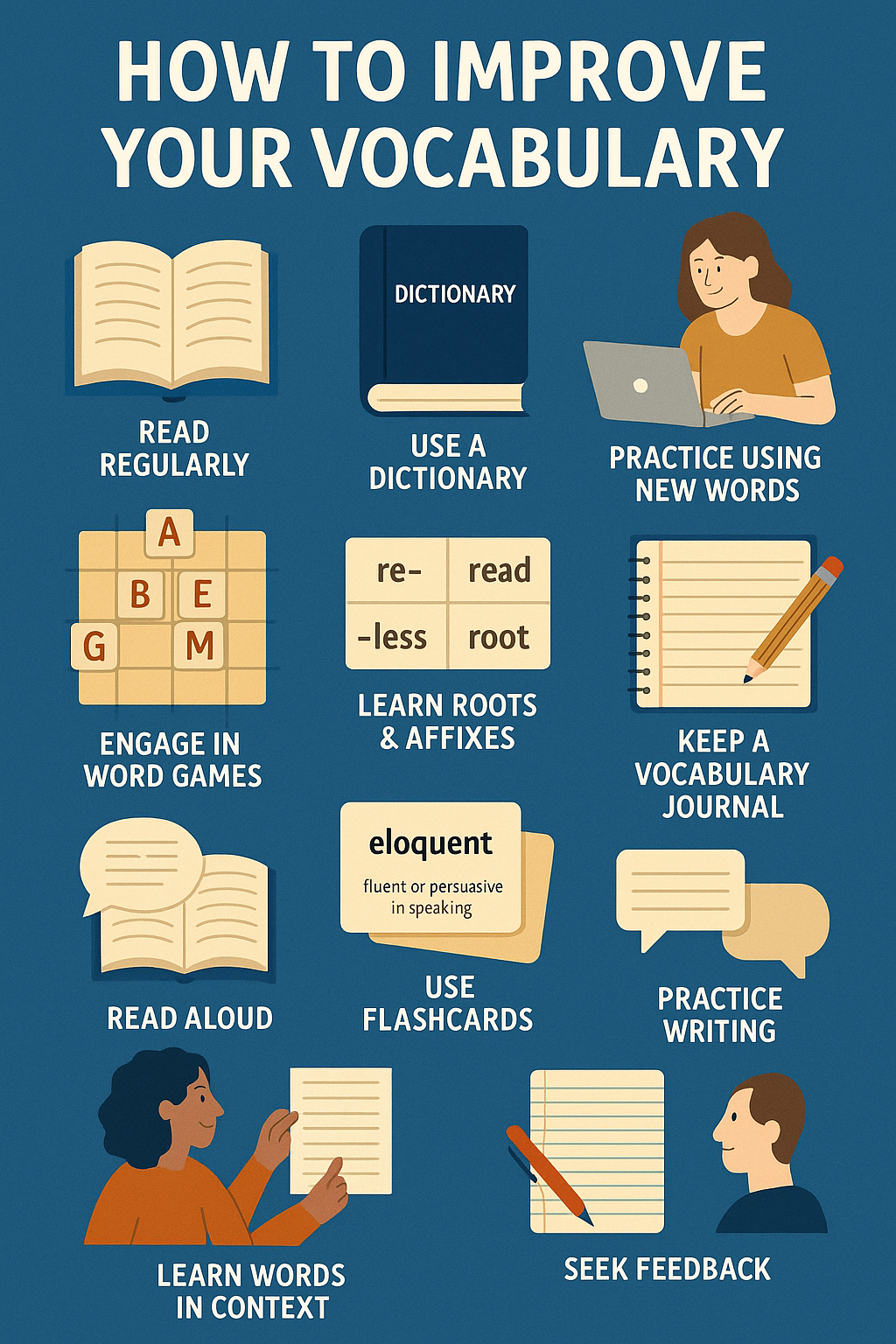
A strong vocabulary is essential for effective writing. It allows you to express your ideas clearly, engage your audience, and enhance the overall quality of your work. Whether you’re writing essays, blog posts, or creative stories, a rich vocabulary helps you convey your message more precisely and with greater impact. In this article, we’ll explore practical strategies to help you expand and improve your vocabulary for better writing.
Read Regularly and Widely
Reading exposes you to new words in context, making it easier to understand their meaning and how to use them. Make a habit of reading a variety of materials, including:
- Novels and short stories
- Newspapers and magazines
- Academic journals
- Blog articles and online content
Diverse reading materials introduce you to different writing styles and vocabulary ranges.
Tip:
Keep a notebook or digital document to jot down unfamiliar words you encounter while reading.
Use a Dictionary and Thesaurus
A good dictionary helps you understand the precise meaning, pronunciation, and usage of new words. A thesaurus, on the other hand, helps you find synonyms and expand your word choices.
When you come across a new word:
- Look up its definition.
- Check its part of speech.
- Review example sentences.
- Learn synonyms and antonyms.
Tip:
Online tools like Merriam-Webster, Oxford Learner’s Dictionaries, and Thesaurus.com are excellent resources.
Practice Using New Words
Learning new vocabulary is only effective if you actively use the words in your writing and speech. Make it a goal to incorporate at least one or two new words into your next writing project.
You can also try these exercises:
- Write sentences using the new words.
- Create short stories or paragraphs around them.
- Use them in conversations with friends or colleagues.
Consistent practice helps reinforce memory and boosts your confidence.
Engage in Word Games and Apps
Word games can make learning vocabulary fun and interactive. Popular options include:
- Crossword puzzles
- Word searches
- Scrabble
- Boggle
- Mobile apps like Vocabulary.com, Elevate, and Duolingo
These games challenge your brain and help you recall new words more easily.
Learn Root Words, Prefixes, and Suffixes
Understanding word roots, prefixes, and suffixes allows you to guess the meaning of unfamiliar words more accurately.
For example:
- The prefix “un-” means “not” (unhappy, unclear).
- The suffix “-less” means “without” (hopeless, tireless).
- The root word “bio” relates to life (biology, biography).
Tip:
Study common prefixes and suffixes to quickly expand your understanding of English vocabulary.
Keep a Personal Vocabulary Journal
A vocabulary journal is a dedicated notebook where you:
- Record new words
- Write their definitions
- Include example sentences
- Note any synonyms or antonyms
Review your journal regularly to reinforce your learning.
Read Aloud and Listen Actively
Hearing words spoken aloud helps reinforce pronunciation and understanding. Try:
- Reading your writing aloud to spot vocabulary weaknesses.
- Listening to podcasts, audiobooks, or TED Talks in English.
- Watching educational videos with subtitles to connect spoken and written words.
Active listening can introduce you to conversational vocabulary and idiomatic expressions.
Use Flashcards for Memorization
Flashcards are a proven technique for memorizing new vocabulary. You can create physical flashcards or use apps like Anki, Quizlet, or Memrise.
On each flashcard:
- Write the word on one side.
- Include the definition, part of speech, and example sentence on the other.
Review your flashcards daily for the best results.
Learn Words in Context
Memorizing word lists isn’t always effective. Instead, learn words in context by:
- Reading full sentences.
- Understanding how words function within a paragraph.
- Relating new words to situations in your life.
Contextual learning helps with long-term retention and practical usage.
Practice Writing Regularly
The more you write, the more opportunities you have to use and reinforce new vocabulary. Set aside time each day or week to write:
- Journal entries
- Short essays
- Blog posts
- Creative stories
Challenge yourself to use new words from your vocabulary journal in each piece.
Seek Feedback and Correction
Ask teachers, peers, or language partners to review your writing and point out weak vocabulary choices. Constructive feedback can help you identify areas for improvement and introduce better word alternatives.
Stay Consistent and Patient
Building a strong vocabulary takes time and dedication. Set small, achievable goals and track your progress.
For example:
- Learn five new words each week.
- Write one paragraph using at least three new words.
- Test yourself regularly.
Consistency will lead to noticeable improvements over time.
Expanding Your Word Power
Improving your vocabulary is one of the most rewarding investments you can make as a writer. It allows you to express your thoughts more effectively, engage your readers, and add depth to your writing style.
By reading regularly, practicing new words, and using effective learning tools, you’ll steadily build a stronger vocabulary that enhances every piece of writing you create.