
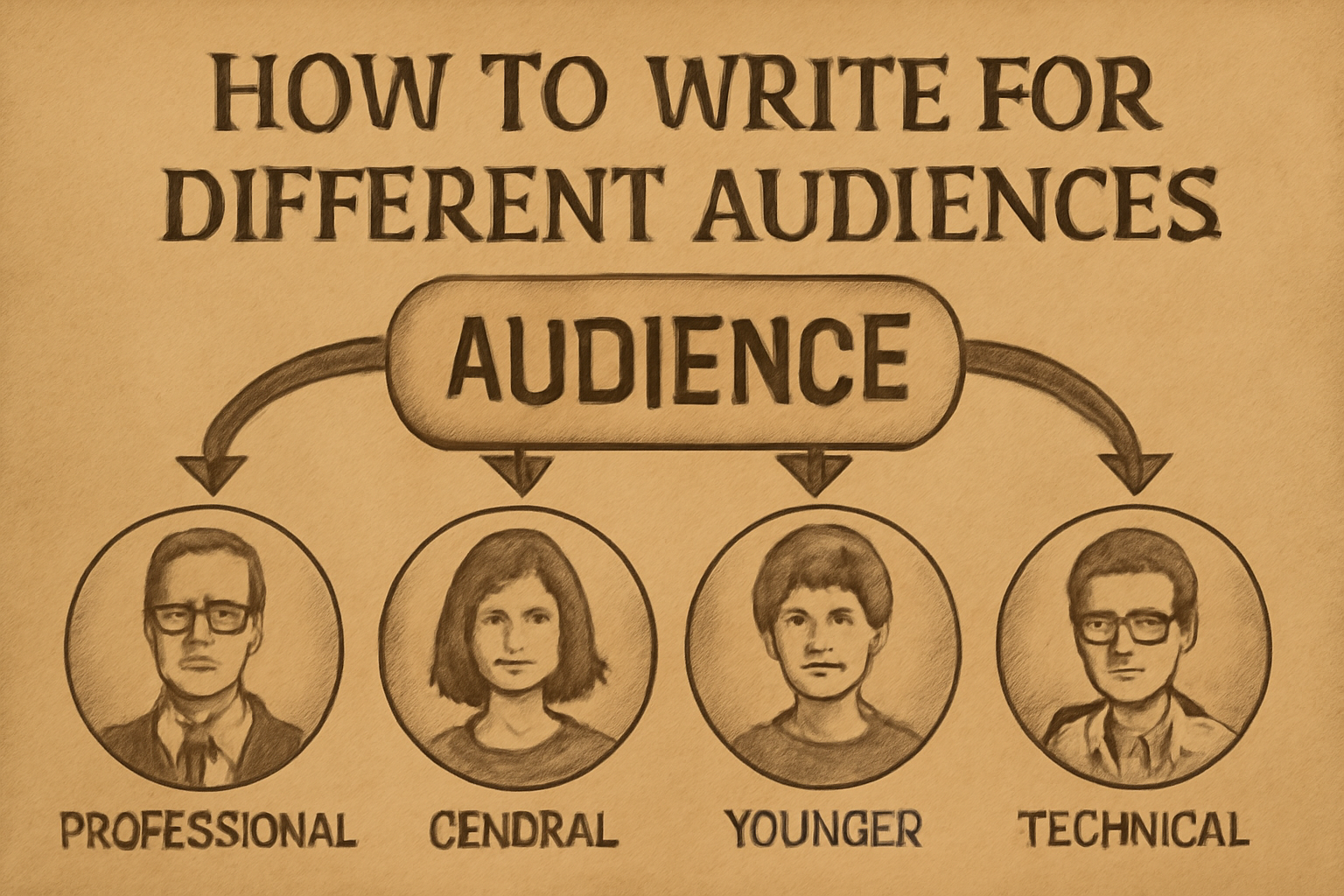
One of the most important skills a writer can develop is the ability to write for different audiences. Whether you’re crafting a blog post, an academic paper, a marketing piece, or even a social media update, understanding your audience and adapting your writing style accordingly can make a huge difference in how your content is received.
In this article, we’ll explore how to adapt your writing to suit various audiences, ensuring that your message resonates and engages effectively with each group.
Why Understanding Your Audience Is Crucial
The key to effective writing is knowing who you’re writing for. Different audiences have different interests, levels of knowledge, and expectations. Understanding your audience allows you to:
- Tailor your tone and style to fit their needs
- Choose the right language and vocabulary
- Present information in a way that’s relevant and engaging
- Ensure that your message is clear and impactful
Writing for the wrong audience can lead to misunderstandings, lack of engagement, or even alienation. On the other hand, writing with your audience in mind ensures that your content speaks to them directly, improving engagement and effectiveness.
Steps to Write for Different Audiences
1. Identify Your Audience
The first step in adapting your writing is understanding your audience. Before you start writing, ask yourself the following questions:
- Who are they?
Are they professionals, students, hobbyists, or the general public? What age group or demographic do they fall into? - What are their interests or needs?
What are they looking for in your content? Are they seeking entertainment, education, or problem-solving? - What is their knowledge level on the topic?
Are they experts or beginners? Tailoring your content based on their level of understanding is essential. - What tone is appropriate?
Should your tone be formal, informal, humorous, or professional? This depends on your audience’s preferences and expectations.
Tip:
Creating a simple profile of your target audience will help you answer these questions and guide your writing approach.
2. Choose the Right Tone and Language
The tone and language you use should align with your audience’s expectations and familiarity with the subject.
- For a professional audience (e.g., business or academic writing):
Use formal, precise language, avoiding slang or overly casual phrasing. Stick to facts, and structure your content logically. Example:
“The findings indicate a significant correlation between employee engagement and productivity metrics.” - For a general audience (e.g., blog posts, social media):
You can use a more conversational tone with simpler language, making complex ideas easy to understand. Example:
“Want to boost your work productivity? Here’s how keeping your team engaged can make all the difference.” - For a younger audience (e.g., teenagers or young adults):
Use relatable, fun, and informal language. You can incorporate humor, memes, or pop culture references to connect with them. Example:
“Stuck at home? Try these simple hacks to make your study time more productive—and less boring!” - For a technical audience (e.g., engineers, scientists):
Use industry-specific jargon and advanced vocabulary to convey expert knowledge. The content should be dense with information and backed by data. Example:
“Our study examines the effects of nanomaterial synthesis on the thermal conductivity properties of carbon-based composites.”
3. Adjust the Level of Detail
The amount of detail you provide should be appropriate for your audience’s level of understanding.
- For experts or specialized audiences:
Include detailed, technical information, research, and data. They are already familiar with the concepts, so you can dive into more in-depth analysis without oversimplifying. Example:
“The data suggests that carbon nanotubes exhibit superior tensile strength when exposed to high temperatures, making them ideal for aerospace applications.” - For general audiences or beginners:
Provide basic explanations, definitions, and simplified concepts. Avoid jargon and break down complex ideas into digestible pieces. Example:
“Carbon nanotubes are tiny structures that are incredibly strong and can withstand extreme heat, which makes them useful in things like space technology.”
4. Structure Your Content Appropriately
Different audiences may prefer different types of content structure.
- For professionals or academic audiences:
Use a clear and logical structure with headings, subheadings, bullet points, and numbered lists. Introduce concepts in a structured way and support arguments with evidence. - For general audiences:
Keep your content engaging by using shorter paragraphs, catchy headlines, and visual elements (images, charts, etc.). Make your content easy to scan and digest. - For younger audiences or social media users:
Use lists, brief sections, and engaging visuals. Break down content into bite-sized chunks to keep it digestible and shareable.
5. Use Examples and Anecdotes
- For experts:
Provide real-world examples, case studies, or historical references that apply directly to their field of expertise. - For general audiences:
Use relatable anecdotes, analogies, and examples that make your topic easy to understand and connect to real life. - For younger audiences:
Use stories or references to pop culture, humor, or current events that resonate with their experiences.
6. Consider the Medium and Format
The platform where your content will appear also impacts how you write.
- For blog posts or articles:
Use an engaging, informative tone and structure that’s easy to read on a screen (short paragraphs, bullet points, headings). - For social media:
Focus on brevity and impact. Use catchy headlines, hashtags, and visuals to catch the audience’s attention quickly. - For emails or business communication:
Be direct and professional, with a clear call-to-action and concise information.
7. Test and Get Feedback
Once you’ve adapted your writing for a specific audience, it’s important to test your content and gather feedback to see if it resonates with them.
- Ask for feedback from people in the target audience or conduct surveys to gauge how your content is perceived.
- Adjust your tone, structure, or level of detail based on feedback to improve future content.
Common Mistakes to Avoid
- Over-simplifying or over-complicating: Don’t assume all your readers need the same level of detail. Tailor it to their knowledge and interests.
- Ignoring the audience’s needs: Always keep your audience’s expectations and motivations in mind while writing.
- Being inconsistent: Make sure the tone, structure, and vocabulary you use align throughout the content.